


Colors
|
|
|
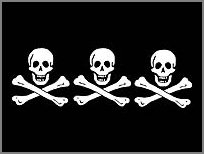
| Pirate flags intimidated potential victims by conjuring up fear and dread of the pirate, especially when combined with a pirate's reputation of not showing any quarter if opposed. If an enemy to heaved-to without offering resistance, the danger to the pirate crew would be eliminated, and the victim's ship could be taken undamaged. | |
|
|
|
 |
Captain
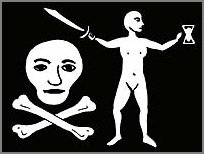
Jean Thomas Dulaien's flag was described by the Mayor of Nantes as
follows: "The flag is made of black materials with white marking
upon it, seems like representations of a head cut off with a cutlass,
together with bones and a sandglass."
|
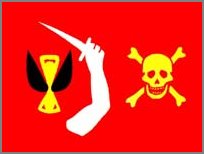 |
Christopher Moody's flag with an hourglass with wings was rumored to mean that his victims time of living was flying away. |
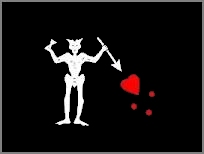 |
Edward Teach's flag was one of the more unusual flags flown by the pirates. His flag had a skeleton holding an hour glass in one hand to signify that your time was running out. A dagger in the other hand and the heart with three drops of blood signified that blood would be drawn if you did not surrender to Blackbeard. |
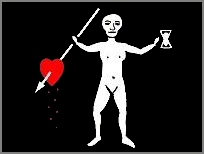 |
In 1703, several Boston Merchants set upon the idea to build a privateer and hunt down French shipping. By July, the vessel was set, and a commission gained. She was to sail under a Daniel Ploughman, who realised the intentions of his prospective crew, and begged the owners to re-assess the situation. The vessel put to sea, and immediately Captain John Quelch threw the captain overboard and seized the ship. |
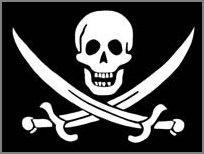 |
Nicknamed "Calico Jack" because of the clothing that he wore made out of calico, John Rackham was typical of many pirates whose sloops preyed on coastal shipping. Little is known of his origins but by 1718 he had somehow made his way to New Providence Island and had joined forces with the only known women pirates, Anne Bonney & Mary Reade who would prove later to be the fiercest fighters among Rackham's crew. |
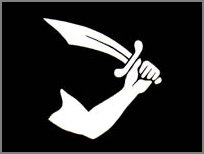 |
Thomas Tew, the Rhode Island Pirate was active in the 1690s in the Red Sea, based in Bermuda, Rhode Island and New York. Tew was killed on an attack on the Fateh Muhammed, an Indian trading ship. During the engagement, a shot carried away the rim of Tew's belly. When he dropped, it struck such a terror into his men, that they offered themselves to be taken, without any resistance. |
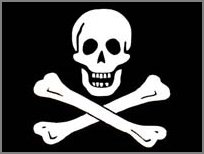 |
Edward
England operated in the Caribbean and the Indian Ocean. He was an
officer on a Jamaican sloop, and upon capture joined the pirate band.
After England escaped he took several prizes along the African coast,
the Azores and the Cape Verdi Islands. He exchanged his sloop for a much
larger ship and named her The Pearl.
|
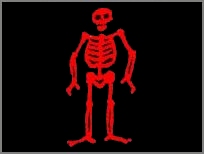 |
Edward Low, a former Boston ship rigger, was known to be an extremely cruel pirate. Even his own men described him as a maniac and brute. He often forced his prisoners to eat pieces of their own flesh before killing them. After being sent adrift by his own crew, he was rescued by a French ship who tried and hanged him soon after learning his identity |
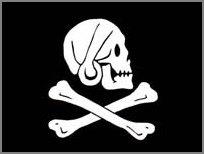 |
The British government once offered 500 pounds for each member of Henry "Long Ben" Every's crew and the East India Trading Company doubled that reward even while Every and several others bought a sloop and escaped to Ireland. Over the years 14 were arrested and 6 were hanged. Henry Every vanished with his plunder never to be heard from again. |
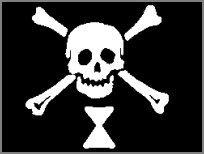 |
The earliest record of a Jolly Roger occurred around 1700 when the French pirate, Emanuel Wynne, flew a sable ensign with cross-bones, a death's head and an hour glass, during an engagement with an English man-of-war off Jamaica. The hour glass may have been a hint that there was not much time for deliberation, a point reinforced by the skull and bones, a traditional symbol of death |
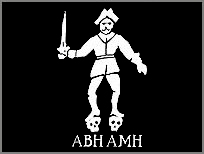 |
Bartholomew Roberts bore a grudge against the island colonies of Barbados and Martinique, so in their waters he used a flag showing a pirate figure standing on two skulls. Under one were the letters 'ABH' (standing for 'A Barbadian's Head'), and under the other was 'AMH' (for 'A Martiniquan's Head'). The threat was clear and sailors from those colonies would expect no mercy if they offered any resistance to Captain Black Bart. |
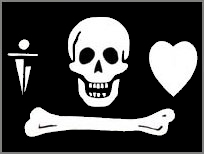 |
Retired
Army Major Stede Bonnet was about the strangest, and most unlikely
pirate of all. In piracy, he couldn't even capture his own ship, as any
respectable pirate would. Instead, he purchased his own, which was
completely unheard of in piracy.
|
 |
Edmund Condent Condent was of a pirate sloop when an Indian, beaten by the other crewmen, threatened to blow up the ship. Condent leaped into the hold and shot him. "When he was dead the crew hacked him to pieces and the gunner - Condent, ripping up his belly, tore out his heart, broiled it and ate it. |

Document Actions